


Hair transplantation is not just a cosmetic procedure. It is a surgical operation that demands extensive clinical expertise. Every graft placement, every incision angle, and every donor area decision shapes the final outcome. Patients often underestimate the surgical complexity behind a successful hair restoration result. This article explains why surgical experience stands as the single most important factor in achieving natural, lasting hair transplant outcomes.
What Makes Hair Transplantation a Surgical Discipline?
Hair transplant surgery falls under the broader category of microsurgical procedures. A surgeon extracts individual follicular units from the donor area and implants them into recipient sites. This process involves tissue handling, vascular preservation, and wound management. Each step requires manual dexterity and anatomical knowledge.
Inexperienced practitioners often treat hair transplantation as a simple transfer of hair follicles. This mindset leads to poor outcomes. The scalp contains complex vascular networks, nerve structures, and tissue layers. A surgeon must navigate these structures with precision. One wrong incision can damage surrounding follicles, compromise blood supply, or create visible scarring.
The surgical nature of hair transplantation extends beyond the procedure itself. Preoperative assessment, donor area evaluation, and postoperative care planning all require medical judgment. An experienced surgeon identifies contraindications, manages patient expectations, and prevents complications before they arise.
How Does Surgical Experience Affect Hair Transplant Planning?
Planning determines success in hair transplant surgery. An experienced surgeon evaluates the patient’s donor capacity, hair characteristics, and future hair loss pattern before making a single incision. This planning phase separates excellent results from mediocre ones.
Donor area assessment forms the foundation of every hair transplant plan. The surgeon examines hair density, follicular unit composition, and scalp laxity. These factors determine how many grafts the patient can safely donate without creating visible thinning. An inexperienced surgeon may overharvest the donor area, causing permanent damage and an unnatural appearance.
Hairline design requires artistic vision combined with surgical precision. The surgeon must account for facial proportions, age-appropriate positioning, and natural hair growth patterns. A poorly designed hairline looks artificial regardless of graft survival rates. Experienced surgeons create hairlines that complement the patient’s unique facial structure.
Long-term strategy matters enormously. Hair loss is a progressive condition. A surgeon must plan for future hair loss, not just the current pattern. This forward-thinking approach ensures the transplant remains natural-looking as the patient ages. Inexperienced surgeons often focus only on immediate coverage, leaving patients with patchy results years later.
What Role Does the Surgeon Play During the Procedure?
The surgeon controls every critical moment during hair transplant surgery. From extraction to implantation, the surgeon’s hands guide the outcome. Experience directly impacts speed, precision, and consistency throughout the procedure.
Graft extraction demands steady hands and sharp judgment. The surgeon must select the right follicular units, maintain proper depth, and avoid transection. Transection occurs when the surgeon cuts through the follicle bulb, rendering the graft useless. Experienced surgeons achieve transection rates below 5%. Novice practitioners often exceed 15%, wasting precious donor hair.
Recipient site creation determines the angle, direction, and density of the final result. The surgeon makes thousands of tiny incisions in the recipient area. Each incision must match the natural hair growth pattern. The depth must accommodate the graft without damaging underlying tissue. The spacing must allow adequate blood flow. One millimeter of error changes the entire aesthetic outcome.
Graft placement requires speed and gentleness. Grafts survive outside the body for a limited time. An experienced surgeon places grafts efficiently while maintaining their viability. Rough handling, improper insertion, or delayed placement reduces graft survival rates significantly.
Why Does Donor Area Management Depend on Experience?
The donor area contains a finite supply of hair follicles. Once removed, these follicles do not regenerate. This makes donor area management one of the most critical aspects of hair transplant surgery.
An experienced surgeon understands donor area preservation. The surgeon distributes extraction points evenly across the safe donor zone. This approach prevents visible thinning or patchy appearance. The surgeon also considers future procedures. A patient may need a second transplant years later. Conservative, strategic extraction preserves donor hair for future needs.
Scarring patterns reveal the surgeon’s skill level. Experienced surgeons create tiny, circular scars that blend with surrounding hair. Inexperienced practitioners leave larger, more visible scars. These scars limit hairstyle options and create psychological distress for patients.
Overharvesting represents a common mistake among inexperienced surgeons. They extract too many grafts from a concentrated area. This creates a moth-eaten appearance in the donor region. Patients cannot reverse this damage. Only an experienced surgeon recognizes the limits of safe extraction and respects them.
How Does Experience Influence Natural Hairline Design?
The hairline frames the face. It defines the overall aesthetic of the hair transplant. A natural-looking hairline requires both artistic sensibility and technical execution.
Facial proportion analysis guides experienced surgeons. They measure the distance between facial features, evaluate forehead shape, and consider ethnic hair characteristics. These measurements create a hairline that looks like it belongs on that specific face. Generic, one-size-fits-all hairlines look obviously artificial.
Age-appropriate design prevents future embarrassment. A 25-year-old patient should not receive the hairline of a teenager. An experienced surgeon designs a mature, conservative hairline that ages well. This approach accounts for the natural recession that continues even after transplantation.
Irregularity creates naturalness. Perfectly straight hairlines look unnatural. Experienced surgeons incorporate micro-irregularities, varying densities, and soft transitions. They mimic the randomness of natural hair growth. Novice surgeons often create rigid, symmetrical lines that signal “transplant” to any observer.
What Causes Patients to Need Revision Hair Transplant Procedures?
Revision hair transplant procedures have increased dramatically in recent years. Many patients seek corrections after disappointing initial results. The root cause almost always traces back to poor surgical planning or improper execution.
Poor donor area management forces revision surgeries. Overharvesting leaves patients with depleted donor reserves. The revision surgeon must work with limited graft availability. This constraint reduces the scope of possible improvements.
Unnatural hairline placement creates obvious cosmetic problems. Hairlines placed too low look juvenile. Hairlines placed too high fail to restore facial balance. Angles that do not match natural growth patterns create a “doll hair” appearance. These errors require surgical correction.
Low graft survival rates waste the patient’s donor hair and financial investment. Inexperienced handling, improper storage, or poor implantation technique kills grafts before they grow. Patients see sparse, patchy results and return for additional procedures.
Scarring and complications from the initial surgery complicate revision work. Scar tissue alters blood supply, changes tissue elasticity, and makes subsequent grafting more difficult. An experienced surgeon from the start prevents these problems entirely.
How Do Long-Term Results Reflect Surgical Experience?
Hair transplant results unfold over 12 to 18 months. The immediate postoperative appearance tells only part of the story. Long-term outcomes reveal the true quality of the surgical work.
Graft survival over time depends on surgical technique. Properly handled grafts establish robust blood supply and grow permanently. Poorly implanted grafts may survive initially but thin out over years. Experienced surgeons achieve consistently high long-term survival rates.
Progressive hair loss management requires ongoing expertise. Native hair continues to thin after transplantation. An experienced surgeon anticipates this progression and plans accordingly. The transplant integrates with the patient’s natural hair loss pattern rather than fighting against it.
Donor area appearance remains stable with expert extraction. Patients should enjoy normal hairstyles without worrying about visible scarring. Only experienced surgeons deliver this outcome consistently. Poor technique leaves permanent marks that restrict lifestyle choices.
What Surgical Techniques Require the Most Experience?
Different hair transplant techniques present unique challenges. Each technique demands specific skills that develop only through repeated practice.
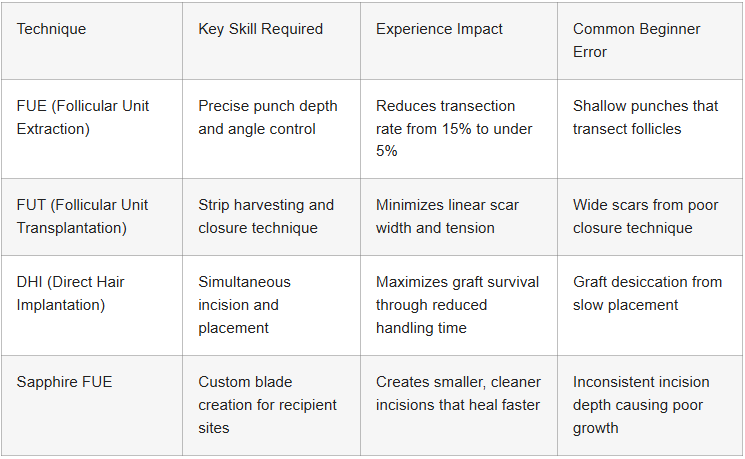
FUE extraction challenges even experienced surgeons. The surgeon must align the punch tool with each follicle’s natural angle. Curved or angled follicles require constant adjustment. Depth control prevents both transection and excessive tissue removal. Only thousands of extractions build this muscle memory.
Recipient site creation with sapphire blades represents another advanced skill. The surgeon customizes blade size based on graft diameter. Smaller blades create less trauma but require precise graft matching. Larger blades accommodate bigger grafts but leave more visible entry points. Experience teaches the surgeon which blade suits each situation.
How Does a Doctor-Led Model Improve Patient Outcomes?
The doctor-led model places the surgeon at the center of every patient interaction. This approach contrasts sharply with technician-driven models where non-medical staff perform critical surgical steps.
Direct surgeon involvement ensures consistent quality. The surgeon evaluates the patient, designs the hairline, performs extractions, creates recipient sites, and supervises graft placement. This hands-on approach eliminates the variability that occurs when multiple technicians handle different patients.
Medical accountability protects patients. When a licensed surgeon performs the procedure, medical standards apply. The surgeon bears legal and ethical responsibility for the outcome. This accountability drives excellence and prevents shortcuts.
Real-time decision making saves procedures from failure. Complications arise unexpectedly during surgery. A surgeon must adjust the plan immediately. Only a doctor present in the operating room can make these critical calls. Technicians lack the training and authority to manage surgical complications.
What Should Patients Look for in a Hair Transplant Surgeon?
Patients must evaluate surgeons carefully before committing to surgery. Several indicators reveal genuine surgical expertise.
Years of exclusive practice matter more than total medical experience. A surgeon who has performed hair transplants for 15 years possesses deeper expertise than a general surgeon who occasionally does hair work. Look for specialization and volume.
Before-and-after portfolios demonstrate real results. Review photos of patients with similar hair loss patterns and hair characteristics. Pay attention to hairline naturalness, donor area appearance, and long-term density.
Surgical technique mastery indicates commitment to excellence. Surgeons who train in multiple techniques and adapt their approach to each patient show professional maturity. One-technique-fits-all practitioners often lack nuanced understanding.
Patient education reveals the surgeon’s priorities. Experienced surgeons explain limitations, set realistic expectations, and sometimes decline patients who are not good candidates. Surgeons who promise perfect results to everyone often lack the judgment that experience provides.
How Does Dr. Emrah Cinik Apply Decades of Surgical Experience?
Dr. Emrah Cinik brings decades of dedicated hair transplant experience to every procedure. He has performed thousands of hair restoration surgeries, refining his technique through continuous practice and patient feedback. His surgical volume translates into predictable, high-quality outcomes.
Top Hair Transplant Surgeon Turkey is not a title earned overnight. Dr. Cinik built this reputation through consistent results, natural hairline designs, and meticulous donor area management. Patients from around the world seek his expertise because his portfolio speaks for itself.
Dr. Cinik operates within a doctor-led model. He personally designs every hairline, evaluates every donor area, and performs the critical surgical steps himself. This direct involvement ensures that his experience benefits every patient directly. He does not delegate the artistic and technical decisions that determine outcomes.
His approach to donor area management reflects surgical wisdom gained over thousands of cases. He preserves donor hair strategically, plans for future needs, and distributes extraction points for invisible results. Patients retain the freedom to wear any hairstyle without concealing scars.
Hairline design under Dr. Cinik’s hand combines mathematical precision with artistic intuition. He studies facial proportions, ethnic characteristics, and age-appropriate patterns. His hairlines grow naturally, frame the face harmoniously, and age gracefully alongside the patient.
Dr. Cinik’s long-term planning protects patients from future disappointment. He evaluates progressive hair loss patterns and designs transplants that integrate with the patient’s natural aging process. This forward-thinking approach delivers results that look excellent not just at six months, but at six years.
What Can Patients Expect from an Experienced Surgeon Like Dr. Emrah Cinik?
Patients choosing an experienced surgeon gain confidence throughout their hair restoration journey. The surgical process becomes predictable, safe, and aligned with their aesthetic goals.
Comprehensive consultation sets the foundation. Dr. Cinik evaluates medical history, examines hair loss patterns, and assesses donor capacity. He explains realistic outcomes and designs a customized surgical plan. Patients leave the consultation with clear expectations and no unanswered questions.
Surgical execution proceeds smoothly under experienced hands. The procedure stays on schedule, graft handling remains gentle, and quality control happens in real time. Patients experience less anxiety knowing that a seasoned surgeon manages every detail.
Recovery and growth follow predictable patterns. Experienced surgeons provide precise aftercare instructions based on thousands of recoveries. They anticipate common concerns and address them proactively. Patients see consistent growth timelines without unexpected setbacks.
Long-term satisfaction defines the ultimate measure of success. An experienced surgeon delivers results that patients enjoy for decades. The transplant blends with natural hair, the donor area remains undetectable, and the hairline continues to look appropriate as the patient ages.
Why Should Experience Guide Your Choice of Hair Transplant Surgeon?
Hair transplant surgery represents a significant investment of time, money, and donor hair. You cannot reverse a poor result. You cannot regenerate wasted donor follicles. The surgeon you choose determines whether this investment succeeds or fails.
Experience reduces risk. An experienced surgeon has encountered complications, solved problems, and refined techniques through real cases. This accumulated knowledge protects you from the errors that plague inexperienced practitioners.
Experience creates naturalness. Only a surgeon who has designed thousands of hairlines understands the subtle details that make a transplant invisible. The angle of each graft, the irregularity of the hairline, and the density gradient all require practiced judgment.
Experience preserves your donor area. Your donor hair is a finite resource. An experienced surgeon treats it with the respect it deserves, extracting strategically and planning for your future needs.
Dr. Emrah Cinik embodies the surgical experience that patients need. His decades of practice, his doctor-led approach, and his commitment to natural results make him a trusted choice for hair restoration. When you choose a surgeon with this level of experience, you choose peace of mind, predictable outcomes, and results that stand the test of time.


