

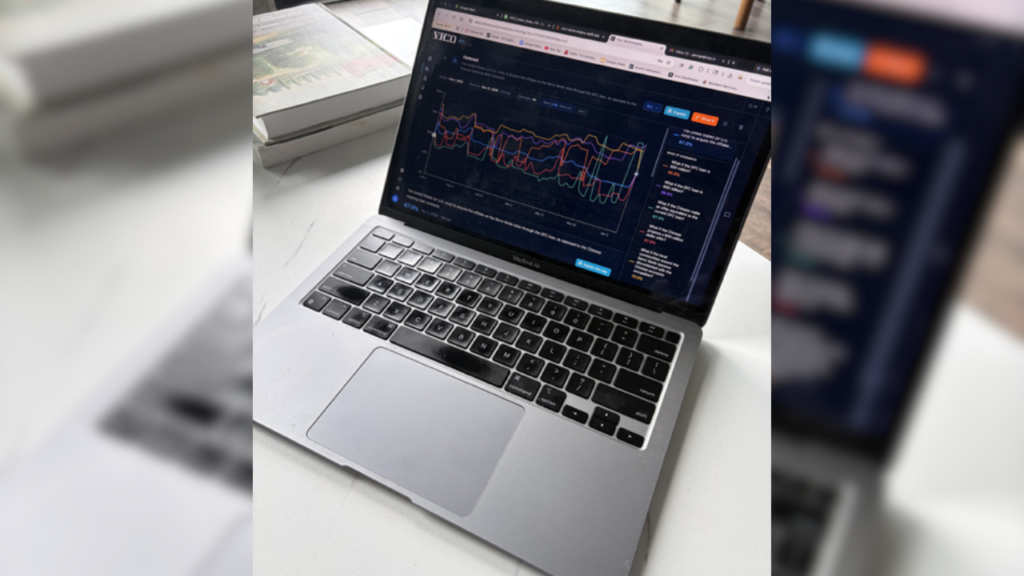
Artificial intelligence in finance has mostly been framed around speed. People want faster trades, faster data processing, and faster access to information. What has been harder to solve is judgment itself, specifically, how institutions process uncertainty when events are still unfolding and reliable signals are buried under noise and conflicting information. That is the pain point Anthony Vinci thinks VICO can help address.
VICO, founded in 2025 by Dr. Vinci and Dr. Lyndon Oh, who both attended the London School of Economics and Political Science, is building what it describes as an AI-powered forecasting, simulation, and scenario-assessment platform designed for decision-makers operating inside complex environments. The system isn’t your basic chatbot or assistant. Instead, it attempts to quantify uncertainty, converting qualitative information into continuously updated probabilistic forecasts.

The company’s broader thesis is that the next major layer of enterprise AI will not simply summarize information better. It will help organizations make decisions under pressure with greater speed and consistency.
Vinci’s career has moved through some of the most analytically demanding institutions in finance and national security. Before launching VICO, he served as a Managing Director at Cerberus Capital Management, where he invested across technology, aerospace, national security, and strategic supply chain sectors. Earlier, he was part of the Core Management Team at Bridgewater Associates, the hedge fund founded by Ray Dalio.
Additionally, Vinci previously served in the government as the first Chief Technology Officer and Associate Director for Capabilities at the National Geospatial-Intelligence Agency (NGA), where he helped oversee the integration of AI into intelligence operations and participated in Project Maven, the Department of Defense initiative focused on military AI applications.
The platform itself combines large language models with mathematical forecasting frameworks and quantitative analysis techniques. According to the company, its models were built after studying how elite analysts process information step-by-step when evaluating uncertain events. VICO says it codified those workflows into a structured AI system that uses Bayesian inference methodologies to generate and continuously update forecasts.
The distinction matters because VICO is deliberately trying to separate itself from consumer-facing generative AI tools as well as prediction-market platforms.
Where betting markets rely on traders, liquidity, and crowd behavior, VICO argues that those systems can become distorted by factors including incentives and reactive momentum tied to news cycles. The company instead positions its forecasting engine as a more scalable and objective alternative built around structured data science and probabilistic modeling.
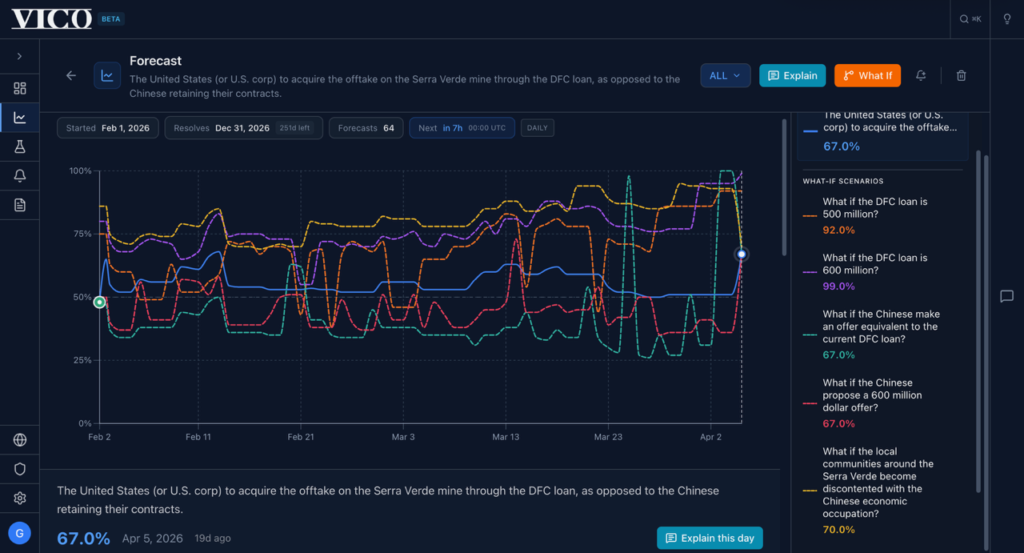
Internally, the company measures performance using Brier Scores, a standard forecasting metric that evaluates the accuracy of probabilistic forecasts. Lower scores indicate stronger calibration between projected probabilities and real-world outcomes. VICO says its models have regularly outperformed both human experts and public forecasting markets in back testing.
The company also claims to have developed proprietary methods to reduce hallucinations, a persistent problem across large language models. Its system reportedly evaluates source bias, structures raw information into proprietary datasets, and uses what Vinci describes as a mathematical “harness” that constrains and validates AI outputs against quantitative frameworks.
That focus on reliability is increasingly important as institutional interest in AI-driven decision infrastructure accelerates across industries.
VICO’s user base already includes portfolio managers, CEOs, and government leaders seeking faster ways to assess rapidly changing situations. Current platform coverage reportedly spans global politics, macroeconomics, tariffs, elections, U.S.-China relations, and geopolitical flashpoints, including tensions involving Iran.
The company has also already secured distribution into institutional finance workflows through integration with the Bloomberg Terminal, giving traders and analysts access to VICO’s forecasting capabilities directly within existing research environments.
Investors appear to see significant upside in the category. VICO recently raised undisclosed pre-seed funding from Crosslink Capital, Gaingels, AIN Ventures, Victoria Six Advisors, and Multiball Capital. The company estimates its broader addressable market opportunity at roughly $400 billion.
That figure reflects a wider shift happening across enterprise AI. For much of the last two years, companies rushed to integrate generative AI into workflows built around content creation and productivity. Increasingly, attention is moving toward systems capable of supporting strategic reasoning itself.
Vinci believes that transition is only beginning. His argument is that modern organizations are drowning in information but still struggling with interpretation. The challenge is no longer access to data. It is determining what matters, how events interact, and how quickly institutions can adapt as probabilities change in real time.
If that turns out to be correct, the next major AI race in finance may not revolve around who can generate the most content. It may revolve around who can generate the clearest judgment under uncertainty.