

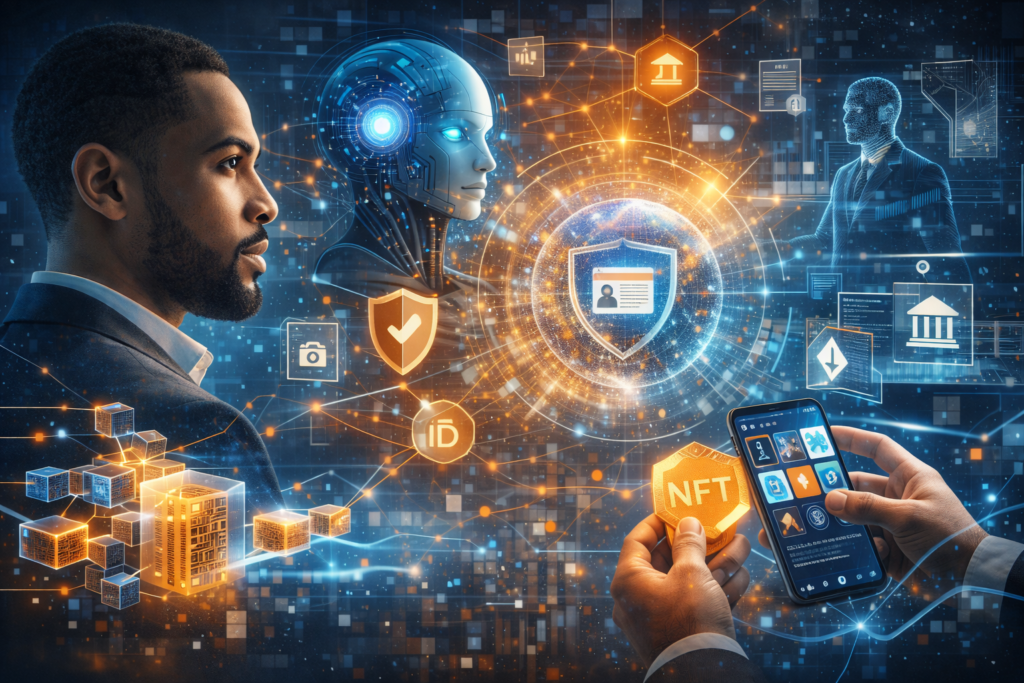
The loudest debates in crypto still revolve around volatility.
The real transformation is happening in architecture.
For Amari Lewis-Simpson, Web3 was never about price charts. It was about programmable ownership and infrastructure that could outlive speculation cycles.
“My involvement in the Web3 space is extensive and multifaceted,” he says. “I have hands-on experience in both the technical and strategic aspects of blockchain technology. I can code and write smart contracts.”
That distinction matters. The current cycle is no longer defined by founders who discovered crypto in a bull market. It is increasingly shaped by operators who understand both capital and code.
Beyond the NFT Hype Cycle
NFTs were declared dead more than once.
Lewis-Simpson never saw them as collectibles to begin with.
“Weventra’s mission was to eradicate ticket fraud, prevent unauthorized resales, and incentivize fan engagement,” he says, referencing the blockchain ticketing company he founded in 2019 after being sold a fake festival ticket. The company went on to provide NFT-based backstage passes for 50 Cent’s Final Lap tour at Wembley and partnered with Roc Nation on digital collectibles.
The core insight was not about JPEGs. It was about verification.
“The true value of digital assets lies in their utility and uniqueness,” he says.
In that framing, NFTs become digital passports. Tickets become programmable assets. Ownership becomes dynamic rather than static.
This is where Web3 quietly matures—when tokens move from speculation to function.
Governments, Metaverse Strategy, and On-Chain Identity
Lewis-Simpson’s Web3 work extended beyond entertainment. His team assisted the Barbadian embassy in becoming the first embassy in the metaverse and developed virtual infrastructure during the pandemic for digital networking.
That experiment signaled something larger: sovereign engagement.
Blockchain was no longer confined to startups. It was being considered at diplomatic levels.
Digital identity, tokenized land, and virtual representation blur traditional boundaries between state, citizen, and network. The metaverse hype cooled, but the strategic implications did not disappear.
They evolved.
The AI Layer Over Web3
If tokenization is the base layer, Lewis-Simpson believes AI may be the multiplier.
“I envision AI playing a transformative role in the future of digital asset management by acting as a personalized digital brain,” he says.
His concept is ambitious: capturing an individual’s expertise within AI models capable of operating independently. A licensed digital version of a financial strategist. A tokenized representation of intellectual capital.
“The concept is to capture an individual’s knowledge and expertise within an AI, creating a virtual version of them that can perform tasks and provide insights.”
Combined with tokenized real-world assets, this creates a new architecture: programmable ownership managed by algorithmic intelligence.
The result is not fully autonomous finance. It is augmented finance.
“I look for businesses that use AI as an additional layer to augment human capabilities, not replace them,” he says. “We need people.”
The Integration Is Happening Quietly
Retail cycles will continue to define headlines. Memecoins will surge and collapse. NFTs will rebrand.
But beneath that noise, the infrastructure is hardening.
Smart contracts are being written for global brands. Digital asset custody is institutional-grade. Sovereigns are experimenting with blockchain frameworks. Emerging markets are leapfrogging legacy systems.
Lewis-Simpson does not see Web3 as rebellion anymore.
He sees it as inevitability.
The early adopters were cultural. The next wave is structural.
Crypto’s first decade proved decentralization was possible. The second decade may prove that it is programmable at scale.
And when ownership, identity, and intelligence operate on the same rails, Web3 will stop being a subculture.
It will simply be how systems work.


