
Let’s be direct about something most families avoid discussing until it’s too late. One in four adults over 65 falls every year. Not might fall — does fall. That’s 14 million incidents annually in the United States alone, costing the healthcare system more than $80 billion. And the most painful part of that statistic is this: the majority of those falls happen when nobody is watching. A parent hits the floor, can’t get up, and lies there for hours because the medical alert pendant they were supposed to be wearing is sitting on the nightstand.
Kami Vision, a San Jose-based Vision AI company, has spent years building technology designed specifically for that moment — and it is now preparing to bring it into private homes for the first time.
The Fall Problem Nobody in Your Family Wants to Discuss
Here’s the uncomfortable truth families avoid talking about at dinner. One in four adults over 65 falls every year. Not might fall — does fall. That’s 14 million incidents annually in this country alone, costing the healthcare system more than $80 billion. And the worst part? Most of these falls happen when nobody is watching. A parent hits the floor, can’t get up, and lies there for hours because their medical alert pendant is sitting on the nightstand where they left it.
Traditional fall detection has a design flaw that no amount of marketing can paper over. Wearable alert pendants and pull cords require the person who has fallen to consciously activate them. If they are disoriented, unconscious, or simply cannot reach the device, the system fails at the exact moment it is needed most. It is a solution built around a best-case scenario in a situation that routinely produces worst-case outcomes.
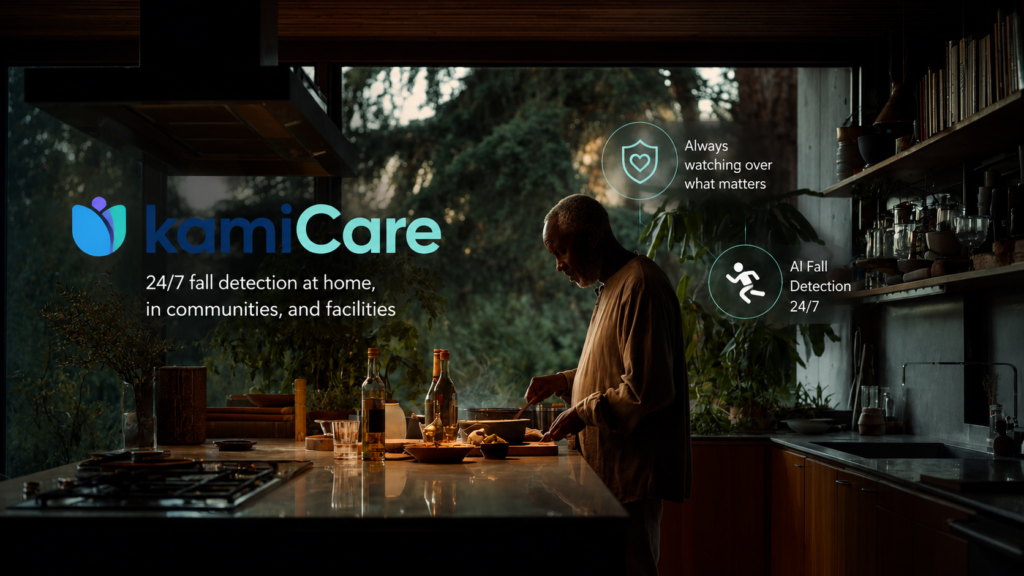
This is where KamiCare changes the equation entirely. The AI-powered camera watches continuously, requiring no action whatsoever from the person being protected. It detects when someone has gone to the ground — whether from a sudden fall, a stumble, or an inability to rise without assistance. Someone scooting across a floor, struggling to get up, or showing early signs that their mobility is declining — these are all signals KamiCare is designed to surface. The technology achieves 99.5 percent accuracy, built on thousands of documented fall incidents collected across years of real-world professional care deployments. No button pressing. No wearable to remember to charge. No dependency on the person in distress to save themselves.
Four Years of Institutional Credibility Before Entering Your Home
What separates KamiCare from the crowded field of consumer home cameras is where it has been before arriving at your parent’s front door.
KamiVision’s KamiCare platform first entered senior living communities and care facilities in 2022, spending the following three years deployed across professional care environments, managing real emergencies, refining detection across thousands of documented incidents, and earning the trust of care professionals with genuine liability on the line. The platform now protects residents across more than 1,000 monitored beds in senior living facilities nationwide.
KamiVision itself operates at significant scale — six million users across 120+ countries, 15+ million devices powered globally, and a patent portfolio of over 60 innovations in computer vision and camera technology. This is not a startup attaching AI labels to a basic motion sensor. It is a company with enterprise-grade infrastructure and a four-year operational track record in one of the most demanding care environments that exists.
The consumer version of KamiCare is currently in beta testing across private homes in the United States, with a full launch expected in the latter half of 2026.

How It Works When It Matters
When a ground-level event is detected, KamiCare’s response sequence moves quickly and deliberately. An immediate alert goes to the resident first, giving them the opportunity to respond directly and confirm they are safe. If they cannot respond, the system automatically escalates to designated contacts assigned during installation — family members, caregivers, or other trusted individuals who have been given access. From there, those contacts can call 911 directly through the app, compressing the gap between an incident and emergency response from potentially hours to minutes.
This escalation model matters. It keeps families in control of the response rather than routing immediately to third-party dispatch, which reflects how most families actually want to manage a parent’s care — with themselves in the loop, making the call.
The Math That Makes This a Serious Financial Conversation
For The Street readers who think carefully about where money goes, the financial case for fall detection technology is straightforward.
Nursing homes with private rooms now average over $10,000 per month. Assisted living facilities run close to $6,000 monthly — costs that rose 10 percent in 2024 alone, outpacing inflation at a pace that is steadily eroding retirement savings for millions of families. A single fall-related hospital admission averages around $30,000. One prevented hospitalization covers years of monitoring costs. That is not a difficult equation.
AARP research indicates that 77 percent of adults over 50 want to remain in their own homes as they age. The demand for technology that makes that preference safe and sustainable is not speculative — it is structural, driven by demographics that are only moving in one direction.
Privacy Built In, Not Added On
Camera-based monitoring in a parent’s home raises legitimate privacy questions, and they deserve a straight answer.
KamiCare records only during detected events, not continuously. Professional monitors who review incidents in the communities and facilities version of the platform see blurred, anonymized footage — unobscured recordings are accessible only to explicitly authorized family members. The consumer version extends this with live view and two-way audio, giving families the ability to check in proactively and communicate directly in the moments after a detected event. These are features that make practical sense in a home environment without compromising the privacy architecture that earned KamiVision institutional trust in the first place.
Your parent maintains their independence. You get genuine peace of mind — not the kind that depends on them remembering to press a button.
What Else KamiVision Is Building
At CES 2026, KamiVision unveiled a companion smart ring they are exploring to track heart rate, blood oxygen, and sleep patterns — extending fall detection and health monitoring beyond the home into mobile environments. For families thinking ahead, the combination of a fixed camera system and a wearable that travels with the person closes the most significant coverage gap in senior safety monitoring.
The company also serves commercial customers through Kami Pro Security, applying the same Vision AI infrastructure to retail, warehouse, and commercial facility environments. Platform diversification reduces risk and compounds the return on KamiVision’s core technology investment.
An early growth round of $10 million from East West Bank helped fuel the foundational buildout that brought the company to its current operational scale — managing 248 million daily alerts and 25 petabytes of data across its existing platform. That infrastructure is what KamiVision now brings to the consumer market.

The Bottom Line
Nobody wants to think about their parents falling. It is uncomfortable, it feels morbid, and there is always something more pressing to deal with today. But 14 million older adults fall every year in this country. That is not an abstract statistic. That is almost certainly someone you know.
KamiCare offers a genuine alternative to the binary choice families have historically faced between institutional care and inadequate protection. A platform proven across four years of professional deployment, now being brought into the home at a moment when the need could not be clearer. The consumer rollout is expected later in 2026.
Sometimes, the most important financial decision a family makes is not about returns. It is about not getting a phone call you could have prevented.