

Written by Jordan French
Messengers have gone beyond being just a tool for exchanging messages. They have turned into multifunctional workspaces, where personal conversations, work tasks, urgent arrangements, deadlines, important reminders, scattered documents, and endless waiting for other people intertwine. Gradually, a problem has arisen, which lies in the relentless growth of incoming information. The flow of chats, notifications, voice messages, and constantly changing contexts strikes at a speed that exceeds a person’s cognitive ability to process it calmly. But the true difficulty lies in the challenge of maintaining focus on the main goals and tasks.
The new reality of messengers
Modern messengers have ceased to be tools for exchanging short messages. They have transformed into dynamic work environments, where personal conversations, work tasks, important agreements, strict deadlines, urgent reminders, document exchanges, and waiting for feedback from numerous people merge into a single stream. The main problem lies in the growth of information volume, which exceeds a person’s cognitive ability for calm processing and distracts from the main thing – the ability to focus on achieving specific goals. Every day, billions of messages are sent and received through various communication platforms, and the average professional actively uses 10 to 12 different applications for communication and collaboration, which further blurs focus and slows progress in achieving set tasks.
According to various estimates, a modern person processes up to 74 GB of information per day on average. This amount includes data received through television, computers, mobile phones, tablets, and other devices. For comparison: 74 GB is roughly equivalent to watching 16 movies.
A minute of a voice message in messengers takes from 350 KB to 1 MB, depending on the application and compression quality. For example, in WhatsApp – about 400 KB/min. If you actively use voice messages (for example, sending 10 minute-long messages per day), about 300 MB of traffic can accumulate in Telegram over a month. Such a huge and often unstructured flow of information becomes an obstacle to concentrating on tasks that lead to main achievements.
The rise in popularity of remote and hybrid work formats has only exacerbated the situation, turning the digital workspace into an arena of endless notifications and urgent requests, which threatens productivity and well-being.
The price of carelessness
The digital flow of information has a direct impact on the efficiency of work and the mental health of specialists. According to research, every second employee receives from colleagues or clients between 10 and 30 messages per hour. This means that during an 8-hour workday, such an employee can receive between 80 and 240 messages.
This continuous flow slows down the workflow and breaks it into fragments, requiring constant context switching. Leading scientific research in the fields of cognitive psychology and productivity management has established that after each such interruption (for example, caused by a notification or urgent message), it takes a person on average 20-25 minutes to fully restore their previous level of concentration and return to the original task. As a result, this distracts from completing tasks and achieving set goals. Over the course of a standard workweek, this leads to a loss of 15% to 25% of total working time, which could have been effectively used to perform core job responsibilities.
The financial assessment of this inefficiency is quite significant. According to Mitel, inefficient communications cost American companies approximately $1.5 trillion annually, which amounts to about 7.3% of the US GDP.
The cognitive load caused by the need to track dozens of conversations, remember minor details, and quickly switch attention between different tasks and projects leads to reduced productivity, increased stress levels, and emotional burnout. Numerous reports on the state of the labor market and employee well-being confirm this trend, pointing to communication overload as one of the main factors of occupational stress.
Existing messenger interfaces are generally focused on the incoming flow of information. They highlight chats based on the time of the last message, the number of unread notifications, or participant activity. However, this approach ignores the user’s real priorities and goals.
The chat list becomes a reflection of external informational noise rather than a tool for purposeful work. This creates a feeling of constant lack of time and lost control, as the user is forced to spend precious energy filtering the chaos instead of completing priority tasks.
The market for collaboration and communication tools, estimated at tens of billions of dollars and continuing to grow actively, indicates a large-scale search for solutions to this problem. Nevertheless, most existing platforms either do not offer radical innovations or focus on superficial improvements.
Vibe Messaging: a revolution in dialogue management
Against the backdrop of digital overload, a new approach to interaction is emerging – Vibe Messaging. This is a paradigm shift in working with information. It is a concept where the user defines their intention, the ultimate goal of communication, and AI agents carry out all the steps on their own. The user only needs to confirm the correctness of the actions at checkpoints.
Thus, intelligent AI agents take on the execution of routine but important tasks: analyzing existing conversations, identifying priority dialogues, suggesting relevant responses or logical next steps, collecting missing context, and even initiating automatic follow-up interactions. This is done to free up the user’s time for strategic thinking and achieving key goals.
The system is designed to help a person consciously manage the entire communication process, directing it toward achieving set goals. It answers the questions: “Who to write to?”, “What exactly?”, “When and with what ultimate purpose?”, turning communication from a routine into a tool for implementing plans. This is a sensible strategy for integrating artificial intelligence into everyday work processes, allowing AI agents to act as highly skilled assistants capable of analyzing large volumes of data, identifying non-obvious connections, and suggesting optimal solutions.
Intellectual layer for communication
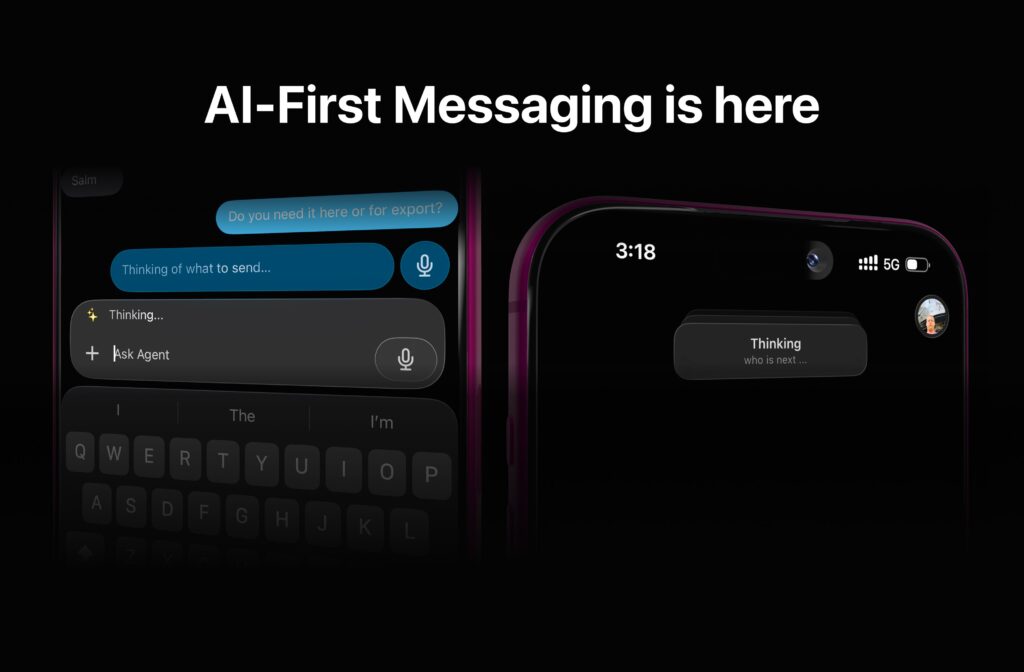
This philosophy is precisely embodied by xflow. It is not another messenger demanding a complete transition of the user to a new platform and abandoning familiar tools. xflow functions as an intelligent layer working on top of already used platforms, such as Telegram and WhatsApp, combining them into a high-quality modern interface.
Instead of presenting the user with an endless list of all chats, xflow helps focus on the most important conversation at the moment, based on the user’s tasks and goals. The system analyzes communication activity, helps determine priorities for maximum contribution to achieving the final result, and suggests the best specific action or response option.
At the same time, final control always remains with the user. Every predicted message requires explicit confirmation. This ensures that all communication remains fully under control and completely aligns with the person’s intentions.
xflow on the global stage
xflow is positioned as a harbinger of a new era in information and communication management. Just as concepts like Vibe Coding change the approach to software development, shifting the focus from implementation details to achieving the desired outcome, Vibe Messaging applies this principle to the realm of human communication.
This is a logical development of the trend where people engage less in routine information processing and increasingly focus on strategic process management, goal setting, and achieving expected results, relying on intelligent support. This transformation coincides with the overall trend toward the intellectualization of work tools.
Conclusion
xflow offers stress reduction and a qualitatively new way of managing communications. It is a transition from reactive interaction to proactive, from information noise to purposeful movement toward set tasks and achieving desired results.
Vibe Messaging, implemented in xflow, opens the door to a future where artificial intelligence becomes an assistant that enhances human capabilities.
This is a story about how technology helps to use information and turn it into a tool for achieving meaningful results, making daily communication a manageable and productive process on the way to goals.